Industry insight
A Better Way to Search for a Car
A practical guide to using budget, daily driving, passenger needs, towing, fuel costs, and ownership priorities to search and compare vehicles without treating AI as a substitute for verification.
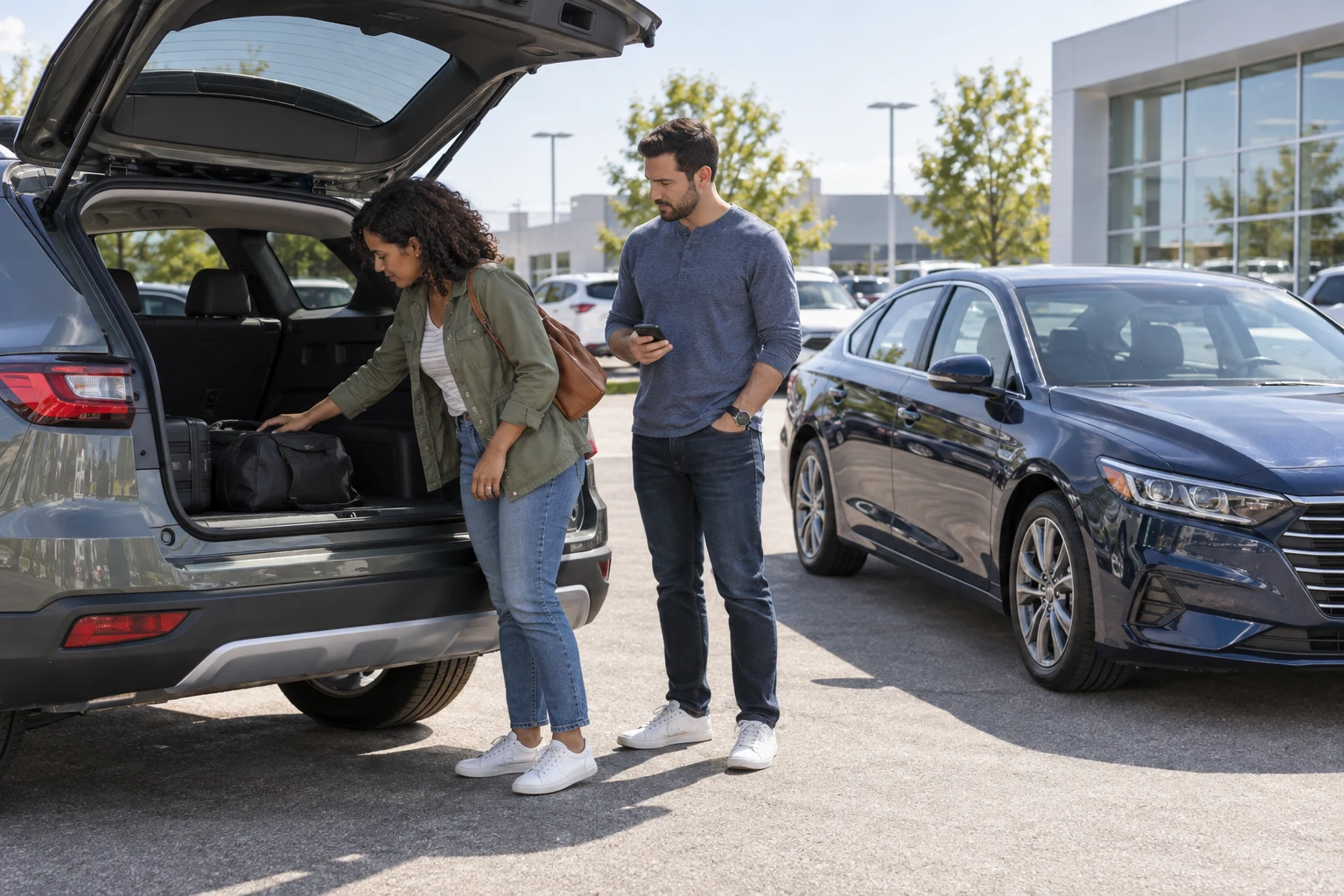
Conversational vehicle search is most useful before a shopper knows which boxes to check. It turns statements such as "I need a reliable three-row SUV under $28,000 for a long commute" or "I need a truck that can tow my trailer" into a structured research path, then lets the shopper test that path against real listings.
The goal is not to let an AI choose a car for you. The goal is to make the first search reflect the way the vehicle will actually be used, preserve the tradeoffs that matter, and help you arrive at the seller with better questions.
That is the approach behind the CarsAndTrucksAI vehicle marketplace, built by Code Expression.
Start with the job the vehicle has to do
Make and model are useful filters when you already know the answer. They are less useful when you are still defining the problem. A parent may care about a third row, but the real requirement is whether adults or small children will use it, how often every seat is occupied, and whether cargo space remains usable with the third row raised. A commuter may ask for good fuel economy, but annual mileage, charging access, insurance, tires, maintenance, and purchase price all affect the ownership decision.
A useful conversational search begins with five kinds of constraints: the budget, the normal trip, the people and cargo, the hard capability requirements, and the tradeoffs you are willing to make. Those constraints create a better shortlist than a string of aspirational features.
Budget should include more than the advertised price. The FTC recommends considering registration, insurance, fuel, and maintenance, and asking a dealer for the out-the-door price in writing before visiting. A lower monthly payment can also hide a longer term and a higher total financing cost. Search can narrow the market, but the purchase decision has to account for the whole obligation.
The normal trip matters because the best vehicle for a short local drive may not be the best one for fifty highway miles each day. The useful questions include where the vehicle will be parked, whether home charging is realistic, how often long trips occur, what road and weather conditions are normal, and how much fuel or electricity the driver expects to use. Shoppers comparing efficiency can use the official FuelEconomy.gov comparison tools alongside marketplace research.
Capability requirements should be specific. "I need a truck" is broad. "I need to tow a trailer with a loaded weight near 7,000 pounds, carry four people, and use the truck as a daily driver" is a research brief. Even then, a general model recommendation is not confirmation that a specific truck is properly configured. Towing capacity depends on the exact vehicle, engine, drivetrain, axle ratio, equipment, payload, hitch, and manufacturer limits. Those details must be verified for the exact unit before purchase.
Use AI to broaden the questions, not manufacture certainty
An AI vehicle guide can help explain why a midsize SUV may suit a mixed commute and weekend use, which ownership considerations deserve research, or how two categories differ. It can also surface questions a shopper may not have thought to ask: Is the third row practical with child seats installed? Does the cargo area fit the equipment you carry? Is the driver's seat comfortable for the length of your commute? How does a hybrid's advantage change if most travel is highway driving?
The assistant becomes less reliable when the question moves from a model or category to facts about one exact used vehicle. It cannot see hidden damage, listen to the engine, confirm that an advertised option is installed, know whether a warning light was recently cleared, or guarantee that the car is still available. It should not present a listing description as an independent inspection.
CarsAndTrucksAI handles this by separating model-level guidance from seller-controlled facts. The AI Vehicle Guide can support research about the year, make, model, everyday fit, fuel economy, safety context, and common ownership questions. The exact vehicle's condition, price, history, availability, fees, financing, warranty, and appointment details remain questions for the dealership or private seller.
That division makes the answer more useful because it makes the uncertainty visible.
Turn the first result into a shortlist
The first plausible vehicle is not a conclusion. A good shortlist usually contains a small set of candidates that solve the same problem in different ways. One may be newer with higher mileage. Another may be older with fewer miles. One may have more cargo room but higher fuel costs. Another may be less expensive but due for maintenance sooner.
Save the listings that survive the first pass, then compare the details that affect your actual use. Price and mileage belong in the comparison, but so do seller, location, body style, powertrain, equipment, accident or title information from a legitimate history source, warranty status, expected maintenance, and the questions still unanswered.
CarsAndTrucksAI keeps saved vehicles, comparisons, and earlier shopping conversations in the same shopper workspace. This prevents an easy but costly mistake: forgetting why a vehicle made the shortlist in the first place. A comparison is more honest when your original priorities remain beside the listing facts.
Treat the VIN as an identifier, not a condition report
A 17-character Vehicle Identification Number is the right place to begin verifying identity for most model-year 1981 and newer vehicles. NHTSA's Vehicle Product Information Catalog and Vehicle Listing service uses manufacturer-submitted data to decode information that may include year, make, model, engine, body, and other specifications.
What a VIN decode does not do is equally important. It does not prove that the title is clean, disclose every accident, confirm maintenance, identify every fitted option, show whether repairs were performed correctly, or certify the current condition of the car. It is one input in the verification process.
For open safety recalls, use the official NHTSA recall lookup. For title, insurance-loss, and salvage information, the FTC points consumers to approved providers available through the National Motor Vehicle Title Information System. A history report can reveal important events, but the FTC is explicit that it does not replace an independent mechanical inspection.
Inspect the car you are actually considering
CarCheck AI gives a shopper a structured way to record observations for a car found on CarsAndTrucksAI, at a dealership, from a private seller, or on another marketplace. The check begins with the VIN, then helps the shopper work through the vehicle one section at a time, keep notes, save questions, and compare up to three checks.
The value is organization. Used-car shopping creates a large amount of imperfect information in a short period. After two or three test drives, it is easy to forget which vehicle had the mismatched tire, which seller promised a service record, or which dashboard warning appeared before the engine started. A private report gives those observations a stable place.
It is still not a mechanical inspection. The FTC recommends arranging an independent inspection even when a used car is described as certified or sold with a warranty. A qualified mechanic can identify issues a visual checklist and history report may miss and can provide a written estimate for needed repairs. If a seller will not permit a reasonable independent inspection, that refusal is information worth considering.
Ask for the final facts in writing
Once a vehicle survives research, comparison, a test drive, and inspection, the conversation becomes specific. Confirm that the exact VIN is still available. Ask for the out-the-door price, including required fees, in writing. Review the FTC Buyers Guide on a dealer's used vehicle, which states whether the car is sold as-is or with a warranty and explains which systems may be covered.
Do not let a useful AI conversation blur that responsibility. The seller controls the exact offer. The buyer is responsible for reviewing the documents and deciding whether the terms fit. Financing, insurance, registration, taxes, return rights, and warranty rules may vary by state and transaction.
CarsAndTrucksAI is designed to make the handoff clearer. Listing pages keep the vehicle and seller attached to the next step. Shoppers can visit the dealership website, call, request contact, message a seller, or continue the conversation with the exact listing in view.
Can AI tell you which exact used car to buy?
No. AI can help turn your needs into criteria, explain categories and model-level tradeoffs, organize questions, and compare information you provide. It cannot inspect the exact car, authenticate every seller statement, predict every repair, or decide whether the price and risk are right for you.
The strongest use of AI in vehicle shopping is preparation. It helps you become a more precise shopper, not a passive one.
Is a VIN decode the same as a vehicle-history report?
No. A VIN decode identifies manufacturer-reported vehicle characteristics. A vehicle-history report may include title, salvage, ownership, insurance-loss, or accident-related records depending on the provider and available data. Neither one tells you everything about current mechanical condition, which is why an independent inspection remains important.
A better search ends in a better human conversation
The real promise of conversational vehicle search is not that it removes the dealership, seller, mechanic, or buyer from the decision. It is that each of those conversations can begin with better context.
Start by describing the vehicle you need on CarsAndTrucksAI. Save the listings that fit, compare them against the same priorities, and use CarCheck AI to organize what you observe before you say yes.
Sources and further reading
Federal Trade Commission: Buying a Used Car From a Dealer explains the Buyers Guide, written out-the-door pricing, vehicle-history reports, financing, warranties, and independent inspections. NHTSA Recalls provides the official VIN recall lookup. NHTSA vPIC provides manufacturer-reported VIN decoding. FuelEconomy.gov provides official vehicle fuel-economy comparison tools.
Related articles
 Company news
Introducing CarsAndTrucksAI
CarsAndTrucksAI connects conversational vehicle search, live listings, saved comparisons, CarCheck AI, private sellers, and dealership inventory in one marketplace.
 AI
AI
AI Sales Agents for Dealer Inventory
A detailed look at how an AI-assisted marketplace can answer model-level questions, preserve vehicle context, and route informed shoppers to the dealership responsible for the exact listing.
 Engineering
Building AI Assistants That Help Without Taking Control
Across Code Expression products, AI is designed as an assistant for drafts, summaries, readiness checks, SEO fields, and workflow guidance while people remain responsible for official decisions.